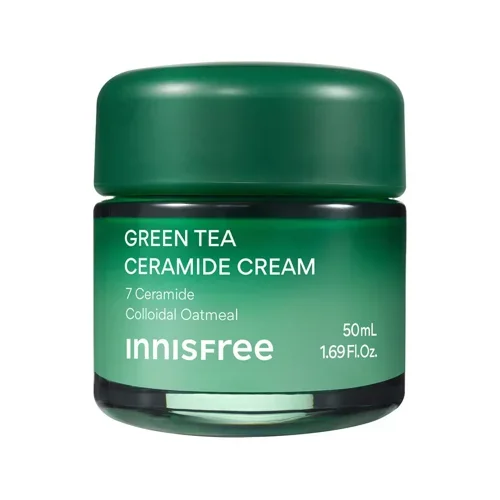
Green Tea Ceramide Cream — Reddit Reviews
by innisfree
Updated November 10, 2026 · Edited by Kayleigh Migdol
Should you buy it?
Ceramide-rich gel cream for redness and barrier support; absorbs cleanly without sticky residue.
Backed by 28 studiesA ceramide-rich gel cream with colloidal oatmeal and ectoin, built for redness-prone skin needing barrier support without a greasy film. It suits combination and sensitive skin, though the richer finish takes time to sink in and can irritate some users.
Where to buy
What Reddit says
Real Reddit threads — 18 mentions across 14 threads
innisfree Green Tea Ceramide Cream on Reddit, in one place — 14 threads from r/40plusskincare, r/Rosacea and 5 more, summarized.
“The best results I've seen so far have been from the Inkey List PHA toner ... and the Innisfree Grean Tea Ceramide cream for redness reduction.”
Positive
“I have an Aestura serum on route.”
Positive
“I’m using Innisfree green tea ceramide cream”
Positive
“The cream is not super thick but moisturizing for my skin”
Positive
“I have a combo skin with type 1 & 2”
Positive
“Innisfree green tea moisturizer”
Cautionary
“it would be lactic acid on top of lactic acid”
Cautionary
“Products that triggered me:”
Cautionary
“Innisfree green tea ceramide cream is so amazing so soft and moisturizing and no sticky greasy tacky film”
Positive
“I use Innisfree’s Green Tea Ceramide Cream, it has cica and oat in it so it helps soothe any irritation I may experience from the azaleic acid”
Positive
“it has watery gel like consistency that absorbs really well”
Positive
“a little goes a long way too!”
Positive
“Currently I use the innisfree Green Tea Ceramide Cream. I like it.”
Positive
“I bought the innisfree green tea ceramide cream yesterday!”
Positive
“I hope it will suit my extremely sensitive skin.”
Positive
Ingredients
Product details
Skin Type
Key Ingredients
Based on limited Reddit discussion so far
Full ingredient list · 48
innisfree Green Tea Ceramide Cream ingredients
Water/Aqua/Eau, Butylene Glycol, Propanediol, Glycerin, Squalane, Dipropylene Glycol, Caprylic/Capric Triglyceride, Simmondsia Chinensis (Jojoba) Seed Oil, 1,2-Hexanediol, Glyceryl Stearate, Ethylhexyl Palmitate, Cetearyl Alcohol, Methyl Trimethicone, Dimethicone, Cetyl Ethylhexanoate, Cetearyl Olivate, Dicaprylyl Ether, Polyglyceryl-3 Methylglucose Distearate, Colloidal Oatmeal, Palmitic Acid, Stearic Acid, Sorbitan Olivate, Hydrogenated Poly(C6-14 Olefin), Carbomer, Tromethamine, Dimethicone/Vinyl Dimethicone Crosspolymer, Ethylhexylglycerin, Cetearyl Glucoside, Xanthan Gum, Caprylyl Glycol, Ceramide NP, Sodium Metaphosphate, Hydrogenated Lecithin, Ectoin, Cetyl-PG Hydroxyethyl Palmitamide, Polyglyceryl-10 Stearate, Camellia Sinensis Seed Extract, Sodium Stearoyl Glutamate, Phytosterols, Camellia Sinensis Seed Oil, Tocopherol, Phytosphingosine, Camellia Sinensis Leaf Extract, Ceramide NS, Cholesterol, Ceramide AP, Ceramide AS, Ceramide EOP
Listed in label order, highest concentration first. Linked ingredients have their own page.
The science
What the science says
Ceramides have some evidence behind their help for the skin barrier, since both studies that tested them directly found benefit 1. In that research, they helped skin hold moisture by reducing water loss and improved dry skin more than usual care did 1. For eczema, the evidence is not proven yet, because results were split: some studies found ceramide creams eased symptoms, while others found them about as good as ordinary moisturizers 2. One study also found a hyaluronic acid foam worked faster than a ceramide cream 2.
- Ceramides for skin barrier Some evidence · 15 studies
- Ceramides for eczema Not proven yet · 13 studies
Research context, not treatment advice. Studies are about the ingredient, not necessarily this exact product.
How we grade research