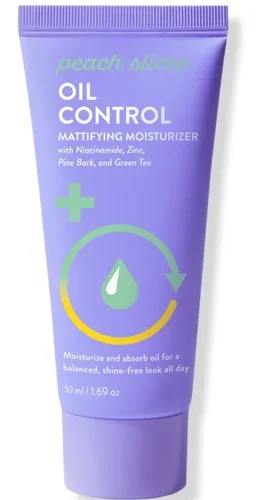
Oil Control Mattifying Moisturizer — Reddit Reviews
by Peach Slices
Updated November 14, 2026 · Edited by Kayleigh Migdol
Should you buy it?
Niacinamide mattifying moisturizer hydrates oily skin and cuts daytime shine; not medicated.
Backed by 53 studiesWhere to buy
What Reddit says
Real Reddit threads — 25 mentions across 17 threads
Peach Slices Oil Control Mattifying Moisturizer on Reddit, in one place — 17 threads from r/SkincareAddiction, summarized.
“Peach Slices Oil Control Mattifying Moisturizer (sold at Ulta)”
Mentioned
“or Peach Slices Oil Control Mattifying Moisturizer.”
Mentioned
“These types of moisturizers contain little particles that absorb excess oils throughout the day”
Mentioned
“which can help minimize pore congestion.”
Mentioned
“it would be totally fine for her to use something like the Peach Slices Oil Control Mattifying Moisturizer”
Positive
“It's very gentle and has hydrating ingredients”
Positive
“it helps minimize pore congestion”
Positive
“Two products that I know of for this are: La Roche Posay Effaclar Mat and Peach Slices Oil Control Mattifying Moisturizer.”
Mentioned
“These hydrate the skin, but also contain microscopic particles that absorb the excess oils his skin is producing.”
Mentioned
“If you have oily skin, try a oil-control moisturizer such as Peach Slices Oil Control Mattifying Moisturizer or La Roche Posay Effaclar Mat.”
Mentioned
“For oily skin, here are some moisturizer options: Bubble Level Up Balancing Gel Moisturizer, Cerave Ultra-Light Moisturizing Gel, Remedy Light Gel Barrier Repairing Moisturizer, or Peach Slices Oil Control Mattifying Moisturizer.”
Positive
“Every time you wash your face, which should be twice per day with oily skin, you need to replenish skin's hydration with a moisturizer.”
Positive
“If you don't, your skin will start to feel dehydrated and could start over-producing oils”
Positive
Ingredients
Product details
Full ingredient list · 48
Peach Slices Oil Control Mattifying Moisturizer ingredients
Water, Cetyl Ethylhexanoate, Cetearyl Alcohol, 1,2-Hexanediol, Niacinamide, Glycerin, Sea Water, Propolis Extract, Zinc PCA, Sodium Hyaluronate, Hydrolyzed Hyaluronic Acid, Hyaluronic Acid, Sodium Acetylated Hyaluronate, Bambusa Vulgaris Extract, Hydroxyethylcellulose, Camellia Sinensis Leaf Extract, Pinus Densiflora Bark Extract, Pinus Palustris Leaf Extract, Glyceryl Stearate, Lactobacillus Ferment, Aloe Barbadensis Leaf Extract, Glucose, Fragaria Ananassa (Strawberry) Fruit Extract, Ulmus Davidiana Root Extract, Pueraria Lobata Root Extract, Polylysine, Gellan Gum, Ceramide NP, Phytosphingosine, Cholesterol, Chamomilla Recutita (Matricaria) Flower Extract, Cynanchum Atratum Extract, Cetearyl Glucoside, Butylene Glycol, Hydroxypropyltrimonium Hyaluronate, Potassium Hyaluronate, Rosmarinus Officinalis (Rosemary) Leaf Extract, Fomes Officinalis (Mushroom) Extract, Oenothera Biennis (Evening Primrose) Flower Extract, Hydrogenated Lecithin, Sodium Hyaluronate Crosspolymer, Stearic Acid, Persea Gratissima (Avocado) Oil, Adansonia Digitata Seed Oil, Macadamia Integrifolia Seed Oil, Elaeis Guineensis Oil, Melaleuca Alternifolia (TEA Tree) Leaf Extract, Caprylyl Glycol
Listed in label order, highest concentration first. Linked ingredients have their own page.
The science
What the science says
Niacinamide has some evidence for acne, where most studies found it helped and it often worked about as well as clindamycin when applied to the skin 1. For dark spots, all four direct studies found it faded them, a finding that has some evidence behind it 2. Two direct studies on signs of aging reported firmer skin and less water loss, and this has some evidence too 3. Its effect on the skin barrier is not proven yet, since a single study found less water loss, so the evidence is thin 4.
- Niacinamide for acne Some evidence · 17 studies
- Niacinamide for hyperpigmentation Some evidence · 17 studies
- Niacinamide for anti-aging Some evidence · 9 studies
- Niacinamide for skin barrier Not proven yet · 17 studies
Research context, not treatment advice. Studies are about the ingredient, not necessarily this exact product.
How we grade research